
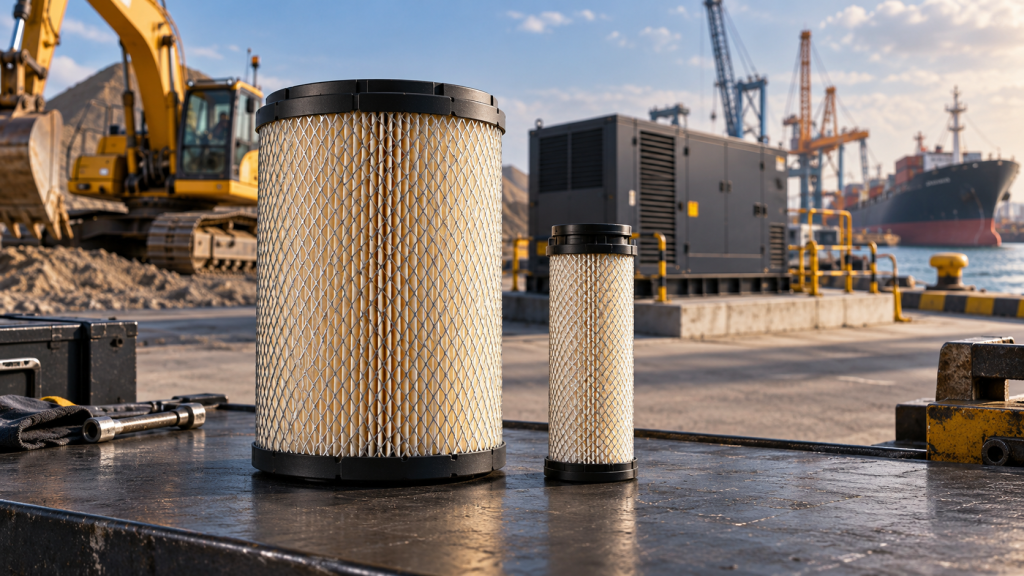
An excavator on a dusty construction site, a diesel generator at an energy facility and a marine engine operate under different conditions. Yet all depend on a reliable supply of clean intake air.
Correct air filter selection requires equipment compatibility, particle capture efficiency, airflow restriction and maintenance needs to be considered together. Purchase price is only part of the equation: servicing costs and equipment downtime also affect the total cost of ownership.
Which Air Filter Does Your Application Need?
In heavy-duty applications, the filter element must match both the equipment and its air intake system.
| Filter or component | Main purpose | Key selection consideration |
|---|---|---|
| Primary dry-type air filter | Captures particles in engine intake air | Equipment compatibility, airflow requirements, sealing and dust capacity |
| Safety filter element | Provides additional protection within a compatible system | Correct fit and the manufacturer’s servicing requirements |
| Cyclonic pre-cleaner | Separates some airborne dust before it reaches the primary filter | Dust conditions and compatibility with the intake system |
| Cabin air filter | Filters air entering the operator’s cabin | Cabin system requirements and the contaminants being addressed |
A safety element does not replace the primary filter. Similarly, a pre-cleaner supports the main filtration system rather than providing complete filtration on its own. Donaldson’s technical guidance describes pre-cleaners as a way to reduce the contaminant load reaching the main filter. Donaldson Air Intake Systems Product Guide
This guide focuses on engine intake filtration. Building ventilation, industrial dust collection and gas turbine inlet systems require separate assessments.
Three Performance Criteria for Air Filter Selection
Particle Capture Efficiency
The filter must capture airborne contaminants before they reach sensitive engine components. A micron rating alone is not enough to compare engine air filters. Filtration efficiency, dust capacity and airflow restriction must be assessed together.
ISO 5011 provides test procedures for comparing these characteristics in air cleaners used with internal combustion engines and compressors. Meaningful product comparisons require results obtained under comparable test conditions. ISO 5011
Application example: For a loader working on a dusty construction site, finding an element that physically fits the housing is only the first step. The part reference, sealing arrangement and manufacturer’s application listing must also be checked. High-efficiency filter media cannot compensate for air bypassing an incorrectly installed seal.
Pressure Drop and Intake Restriction
Air encounters resistance as it passes through a filter. The pressure difference across the filter and the restriction created by the complete intake system are related but distinct measurements.
There is no universal replacement threshold suitable for every machine. The engine manufacturer’s specified limit must be used, with readings taken under the appropriate operating conditions. Donaldson recommends monitoring intake restriction and observing the engine manufacturer’s maximum allowable value. Donaldson’s restriction-based servicing guidance
Application example: A generator reading taken at low load should not be compared directly with a full-load reading. Maintenance records should include operating conditions and engine hours alongside the measured value.
1 Question : Does a Dirty Air Filter Always Cause a Rich Air–Fuel Mixture?
A dirty or clogged air filter can restrict the engine’s air supply. In carburetted petrol engines, this can increase the proportion of fuel relative to air, resulting in a rich mixture. However, this explanation does not apply to every engine type.
In modern fuel-injected petrol engines, the electronic control system adjusts fuel delivery using sensor data. A dirty air filter therefore does not necessarily cause rich running, although excessive restriction can limit performance, particularly under high load.
In diesel engines used in construction equipment, generators and marine applications, insufficient air can contribute to power loss, soot formation or black smoke, depending on the engine design and control system. Electronically controlled engines may limit fuel delivery and power output in response to the available air supply.
Air filter replacement should therefore not be based solely on visible dirt or exhaust smoke. Intake restriction should be measured, the filter and intake system checked for damage, and the equipment manufacturer’s maintenance instructions followed.
Dust Capacity and Service Life
Dust capacity describes the amount of contaminant a filter can retain before reaching a specified restriction limit. Laboratory performance does not guarantee a fixed number of operating hours in the field: dust characteristics and operating conditions vary. Donaldson’s explanation of air filter efficiency
Service life should therefore be tracked by equipment and application. A filter used in a relatively clean environment may behave differently from the same element operating in persistent airborne dust.
Maintenance Priorities by Industry
Construction and Heavy Equipment
For equipment exposed to heavy dust, the maintenance plan should cover the complete intake system. Pre-cleaners, dust discharge components, intake hoses and connections deserve attention alongside the primary element.
Where technically suitable, a compatible pre-cleaner can be considered to reduce the dust load reaching the main filter. Selection should follow the equipment and intake system requirements.
Energy and Generator Applications
Continuously operating generators and standby units need different maintenance planning. Engine hours should be considered alongside the manufacturer’s calendar-based requirements.
For critical installations, identify the correct replacement elements in advance and make them available before scheduled servicing or load tests.
Marine Applications
Marine air filter selection begins with the engine installation and the location of the air intake. Where salt spray or high moisture exposure is possible, a standard dry-type element should not be assumed to address every environmental challenge.
Confirm the application requirements with the engine and intake system manufacturer, including any additional protective measures required for the installation.
Kaya Grup’s Filtration Brands and Technical Support
Kaya Grup Filtrasyon Sistemleri A.Ş. offers a broad filtration portfolio featuring Donaldson, Fleetguard, MANN-FILTER, MAHLE, Parker, HIFI Filter, Fil Filter, Argo-Hytos, Filtrec and Sure Filter, alongside its own WERAUS brand. Its distributor, dealer and solution-partner relationships vary by brand. Kaya Grup’s filtration brands
This portfolio covers air, oil, fuel, hydraulic and other filtration requirements. For a specific air filter application, availability and suitability must be verified using the equipment details, part reference, airflow requirements, sealing design and product specifications. Matching dimensions alone do not establish equivalent performance or approval.
To support product identification and technical assessment, provide:
- Equipment make, model and engine details.
- The existing filter part number and a readable label photograph.
- Operating conditions, daily usage and current maintenance intervals.
- Available restriction readings and any recurring problems.
Where field service is needed, the request can include housing and seal inspection, intake line checks, restriction indicator assessment and maintenance record review. Confirm the availability and scope of on-site services with Kaya Grup before scheduling the work.
Six Steps to a Cost-Effective Maintenance Programme
- Create an equipment register. Match each machine to the correct filter references and manufacturer’s maintenance instructions.
- Record a baseline. When installing a new element, record the date, engine hours and, where applicable, the restriction reading under defined operating conditions.
- Track changing conditions. Review monitoring frequency when dust exposure or equipment duty changes.
- Use condition-based evidence. Follow the manufacturer’s instructions, restriction readings and damage criteria rather than appearance alone. Unnecessary removal can introduce contamination or installation errors.
- Check cleaning permissions. Do not wash elements or use compressed air unless the manufacturer explicitly permits that procedure.
- Plan replacement stock. Have the correct filter available before maintenance begins and verify installation before returning the equipment to service.
Compare Cost per Operating Hour
A lower purchase price does not automatically mean a lower operating cost. Compare products over equivalent periods using:
Maintenance cost per operating hour = (Filter cost + replacement labour + downtime cost attributable to filter maintenance) ÷ operating hours
For example, a fleet considering an application-approved WERAUS alternative could track restriction trends, replacement intervals and maintenance costs on equipment performing comparable duties. This is an evaluation method, not a claim of proven savings. Any conclusion about longer service life or lower cost should be supported by recorded field results.
Optimising uptime means maintaining protection while avoiding unnecessary intervention. A documented air filter selection and maintenance process helps teams schedule necessary work, prepare replacement stock and make better-informed purchasing decisions.
Share your current filter reference, equipment details and operating conditions with Kaya Grup to discuss suitable products, technical support and replacement planning.